
All Good Things in Threes
The Failings of BSOLO and the Three-Solution Problems of Quest for Glory
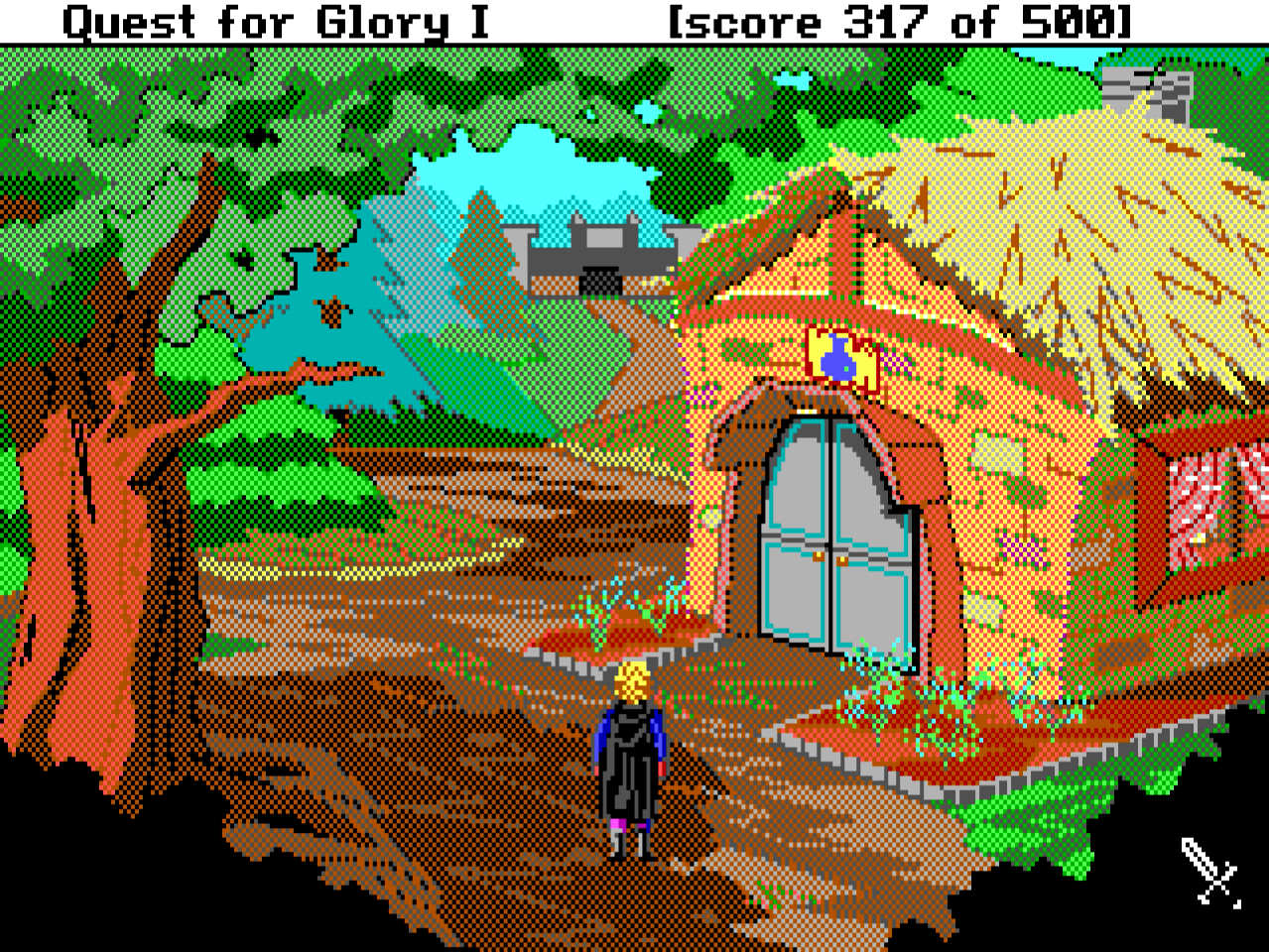
This post is, in part, a play report and review of BSOLO: Ghost of Lion Castle, while also being a rumination on how the same design challenges were handled better in the classic Sierra adventure game series Quest for Glory. I overall enjoyed playing through BSOLO over the past week after hearing the guys discuss it on Between two Cairns. But, I enjoyed it spite of itself, and there are some serious problems with the adventure I think I would handle differently if I were writing it myself. Throughout my playthrough, I kept thinking of the Quest for Glory series, which had similar design constraints, but handled them in a way that still allowed more of a feeling of player agency. The whole experience has me thinking about writing a solo old-school adventure of my own, which may be a project I take on in 2026.
This post contains spoilers for BSOLO throughout, and you may want to wait to read it if you plan on playing the adventure yourself.

My Experience of BSOLO
My experience of playing BSOLO was very much like my experience playing the Quest for Glory and King’s Quest games as a kid. Namely, I died a lot and had to attempt the same things multiple times before I made it through them. The major difference, of course, was that I had to roll up a new character each time that happened in BSOLO rather than simply going back to a save point. There’s something interesting about that, especially with how BSOLO enables you to loot your past characters when you find their bodies and learn what they learned from the “Magic Journal.” But, it was also a bit frustrating with how often you can die simply by walking into a room or failing an initiative roll.
The concept of BSOLO is that you hear about an ancient wizard’s castle shaped like a lion and you have to go in by yourself to try to find treasure and become the heir of the ancient wizard. The first challenge is getting inside the castle by finding the right entrance and/or using the right magic item(s) and making some saves to avoid being killed by the traps guarding the entrance. Once inside, it’s mostly a challenge of figuring out how to move around between the different levels and sections of those levels, which often requires switching between one of four staircases to get where you need to go. All the while you’re facing off against random encounters and traps that are in many of the rooms.
There’s a set of modified B/X rules to guide your playthrough, and I combined these with OSE, using the dungeoncrawling procedures to track encounters, rest points, and light outside of what the game required, as I felt like that made for a better experience. The rule changes mostly cover how to handle dealing with monster reactions without a DM running things for you and limiting magic items and spell use to provide fewer options so that you can work within the choose-your-own-adventure style presentation of the adventure.
It ultimately took me 10 characters to beat the adventure and become the heir of sargon. I did a mix of the pregenerated characters from the adventure and some that I rolled up for myself. Below is a brief summary of each with how long they lasted (in dungeon turns), what they did along the way, and how they died. I unfortunately didn’t write down which character was which in my notes, but I played a mix of Level 1-3 magic users, elfs, clerics, a halfing, and finally a Level 3 fighter, who was the one that made it to the end of the adventure.
Character 1
Made it 10 turns. Died fighting a giant ferret in the postern gate tunnel.
Character 2
Made it 7 turns. Died from glowing arrow trying to go through castle front gate.
Character 3
Made it 8 turns. Killed a hobgoblin in the postern gate tunnel. Explored rooms on Level I and found a hammer. Died on the roof fighting a giant oil beetle.
Character 4
Made it 15 turns. Used potion of gaseous form to float through the postern gatehouse, but lost all my gear. Talked to an orc in the postern gate tunnel and split the loot from Character 1’s body with it. Ran away from a beetle by throwing food. Explored rooms in the East Dungeon. Found a dagger and spell scrolls. Killed by swinging axe walking into the Treasury.
Character 5
Made it 11 turns. Ran away from wereboar in the postern gate tunnel. Found a well in the dungeon and got transported upstairs. Found sweet wine. Killed by a giant draco lizard after it ignored the food I threw for it.
Character 6
Made it 5 turns. Killed by molten lead trying to go through front gate.
Character 7
Made it 26 turns. Used rope of climbing to climb up outside of tower. Explored rooms on Level III. Eventually found way to room with a giant ruby but got teleported to the dungeon after taking it. Worked my way back up to the ruby room. Ran away from a giant ant after throwing it food. Found a potion of healing. Found the stairs to Sargon’s study. Killed trying to run away from a weretiger.
Character 8
Made it 4 turns. Killed by a giant crab spider in the postern gate tunnel.
Character 9
Made it 17 turns. Went straight to Sargon’s rooms. Looted potion of healing and ruby from Character 7. Found a weretiger! Ran away from it. Used healing potion. Went back and found a crab spider. Killed by crab spider in Sargon’s study.
Character 10
Made it 12 turns. Went straight to Sargon’s rooms. Fought and killed a giant ant in Sargon’s study. Became heir of Sargon.
The Good of BSOLO
I’m going to talk mostly in the rest of this post about the problems I had with this adventure, but before that I’d like to go through some of the things I actually did like about it. Clearly it was fun enough for me to play through with 10 characters over several days of play, and it’s not all bad.
1 - Navigation Challenges
From a modern OSR perspective, I think the biggest strength of the adventure is the way it turns navigating the dungeon itself into a challenge. I thought the level design was surprisingly good for being a six-floor building with all the floors connected by four different staircases. Some staircases only open into one part of a level, some levels are split in half, and there’s more than one place where you’ll be teleported randomly to a different part of the castle. Altogether, I thought these worked well, and I found myself having to think and go back to the maps multiple times to figure out how exactly to get where I wanted to go. It also worked well cumulatively as each character learned more about it and their knowledge was shared to the next one through the “Magic Journal” that magically goes back to the tavern you start at after each death.
2 - Humor
There are some genuinely funny parts of the adventure that reminded me of the humor of the classic Sierra games I’ll discuss more later. My favorite was the room labeled “Pet Food,” inside of which it promptly announces that “You Are the Pet Food!” and you’re attacked by a monster. It was nice to have a bit of levity amid all the times I died playing it.
3 - Theme
The adventure gave me classic adventure game vibes throughout, and my inner child enjoyed it for that despite the failings of it. The lion-shaped castle is cool as hell. The first-person perspective art really puts you into it, and I wish there had been more of that. The random assortment of rooms, and their descriptions felt apt for what it was, as did the random assortment of monsters and the werebeasts. Sargon’s pointy skullcap is perfect.
4 - Rule Changes
The few rule changes around how to handle monsters you share a language with, how to handle combat in the dark, and how to handle running away from monsters were all great. Despite how often I died, it always felt like there were a few things to try to get around combat, even if they didn’t always work.
The Bad of BSOLO
With the good out of the way, I can’t emphasize enough how much BSOLO fails at what could have been a really good concept when I compare it to computer adventure games of the same time period (technically a few years later, but close enough). I think the choose-your-own adventure format is perfectly fine for this kind of thing, and I really want to try to write one myself in the same format, but it fails to fully exploit what it could be doing with it in several ways.
1 - Class Limitations
While there’s nothing stopping you from playing whatever you want (as I did) the adventure implies that you can only succeed as a magic user or elf. I presume this is because they wanted to limit the types of solutions players would try, but there’s no real reason to have done that, as I’ll discuss below. And, even then, the adventure itself doesn’t really reward you for playing a magic user or elf anyway. Technically some of the magic items the pregens get help you get inside, but even then they only help to a certain extent. Once you’re inside, there’s no real challenges to overcome apart from navigating the structure. The rest of it is either saves, automatic damage, or monsters. Yes, invisibility or sleep spells could help, but only one of the pregens even gets sleep, and one gets a ring of invisibility. It ultimately feels like a bait-and-switch, as the pregen magic items mostly help you get inside, but then you really just need to be able to survive damage once you’re inside if you want to make it. That’s why I ended up doing a Level 3 fighter as my final character so that they could survive more than one hit in a fight or one of the random rooms that damages you.
2 - No Real Challenges
As I touched on above, there’s no real challenges once you get inside the castle. Each of the entrances presents several possible solutions for getting in (gaseous form, invisibility, rope of climbing, running, sneaking, etc…), and it felt meaningful in those cases how you chose to tackle the problem. But that stops once you’re in the castle. Inside any of the dangers are just a save or automatic damage, and there’s no actual problems to solve. With encounters, you have a 50% chance of escaping if you throw food or treasure out, and you can try to get away by running, but anyone with armor is by default slower than the monsters and doesn’t really stand a chance. I feel like this was done because they didn’t want to implement problems with multiple solutions throughout, presumably because of the limitations of the format, but I don’t think that’s really a good excuse. You absolutely could have had more real challenges in it and provided tools throughout the dungeon or with the pregens to help overcome them.
3 - Arbitrary Death
I’ve already covered it, but just to emphasize again, it is so easy to die in here. Plenty of rooms you walk into will do 1d6 or more of damage just for walking in, while others do damage on a save, and many of the monsters do 1d8, 1d10, or even 2d6 damage and can easily one-hit your character if you aren’t able to escape them.
Three-Solution Problems in Quest For Glory
What I find most frustrating about BSOLO is that other games from around the same time (yes, technically 5 years after BSOLO) do successfully implement as system in which you can have multiple player classes available and multiple solutions to problems while not overly limiting what players can do. While there’s many adventure games to choose from, my personal touchstone is the Quest for Glory series. I played the shit out of Quest for Glory III around the ages of 8-12. I was terrible at it, and mostly just wandered around exploring the world, fighting random encounters, and talking to people, and only made it about ¾ of the way through the storyline. I didn’t actually beat that game until a few years ago. But I loved it so much. However, I’ve played a lot more recently of Quest for Glory I, and that’s the main one I’ll be talking about here.
Quest for Glory Classes
Quest for Glory is a classic adventure game in which your character moves around different squares of a grid map of the world and goes on quests. You collect items, talk to people, and solve problems, all while having a limited set of actions you can take. The first two games are text-interface, while later entries in the series were point-and-click. What sets it apart from other similar games of the time (e.g., King’s Quest) is that you can play one of three classes (magic user, thief, or fighter) each of which gives you access to unique side quests items that the others can’t use. It also has a bigger emphasis on fighting than other similar games. This means you can play through multiple times while having a unique experience each time. Fighters get armor and a sword for fighting head on. Thieves get throwing daggers. Magic users get spells (and daggers). Each also benefits more from different ability and skill points, although you can also work across classes in that regard. I won’t go into it more here, as the game mechanics are well-discussed elsewhere, but I think it’s a great system.
Quest for Glory-Style Problems
The game shines in how it implements problems for you to solve while working within the limited actions and also allowing for unique approaches between the three classes. Some problems require you to find an item elsewhere to solve, a standard approach in adventure games like this, while others require you to find the right action to take. As an example, at one point you need to get a lost necklace out of a tree. The magic user can simply use a spell to pull it down. The fighter is best served by throwing a rock at it. The thief has the easiest time climbing the tree. But, none of them are limited there either. While thieves progress in climbing more easily, you can grind your way to a higher climbing skill with either of the other classes and do it that way; the same goes for the throwing skill as well. At a different point, you have to face off against a monster to get an item. You can sneak around it as the thief, fight it from range with a spell as the magic user, or fight it head on as the fighter. Again and again in the game, each problem has a minimum of three solutions, each suited best to one of the three classes, but also not being exclusive to the classes. I always enjoyed the feeling of agency you get playing through it as the different classes and trying out different solutions, even if that meant grinding for 20 minutes to get my fighter’s climbing skill up to be able to go up a tree. I wasn’t artificially locked in by the game to one way of doing things. And, I think the same could be done in a BSOLO-style adventure.
How to Implement in a Solo TTRPG
I think the answer to how to do a better version of BSOLO is actually contained within the adventure itself in how they handled getting into the castle. As I noted, at each entrance you’re offered several options for how to get in, based on the items the pregen characters have or different actions you can take. I think you could implement this throughout the adventure by 1) seeding items around that are intended to solve specific problems so that you ensure characters get the items they need and, 2) thinking about solutions specific to the classes so that multiple classes are viable and players are rewarded for thinking about how to use what their characters can do.
As a simple example, you could have a locked wooden door blocking a key pathway. The B/X rules naturally offer multiple class-based solutions to this, which you could augment in the adventure. A set of options could be:
- Use a key hidden in another part of the dungeon
- Burn the door down
- Use the open doors skill
- Use a spell
- Pick the lock
While I may be forgetting some potential options here, I think that’s already a pretty comprehensive list, and you could potentially add a catchall option for other solutions players might think of and assign an x-in-6 odds for it working or some other way of adjudicating it.
While that does increase the number of entries you need to write, I think it would be an overall more fun experience, and I do think I’ll try my hand at writing up a version of it this year to see how it goes.