
Choose Your Own Direction
Musings on Maps and Navigation in Lathan's Gold
Earlier in the year I spent some time playing through the solo B/X adventures TSR released back in the 80s. While I already wrote about Ghost of Lion Castle and Thunderdelve Mountain, I'd been stuck on what to write about Lathan's Gold. This is because it's completely different than the others, and barely qualifies as actually playing D&D in my opinion. Sure, you and the monsters have D&D stats, but the majority of the gameplay is actually just the logistics of recruiting a large enough crew for a ship with the right mix of sailors and fighters and maintaining them with gold and rations long enough to make a journey and return. Combat is just comparing numbers on a matrix based on the average stats of each side, and is primarily won just by having more people on your side.
The other main part of the game is ocean navigation, and the most recently Blogging Bandwagon made me think this would actually be an interesting thing to talk about, as I find it (perhaps unintentionally) mimics the realities of early ocean navigation in some interesting ways.
Ocean Navigation in Lathan's Gold
Ocean navigation in this adventure is simplified from the B/X procedures. You 1) choose a direction, 2) check for encounters, 3) check for being lost, and 4) pick a direction to go and see what happens. The specifics of how things work in this sequence very with how far from the coast you are. While hugging the coast or going on established trade routes, there's no chance of getting lost, but hiring an experience captain helps you travel faster. While voyaging on open ocean, hiring an experienced navigator stops you from getting lost.
While this simplifies some of the B/X procedures, which would normally also consider travel speed and wind, and it can't exactly be said to be realistic, what I found interesting while playing it is how the way information is presented vaguely mimics some of the difficulties of actual early modern navigation.
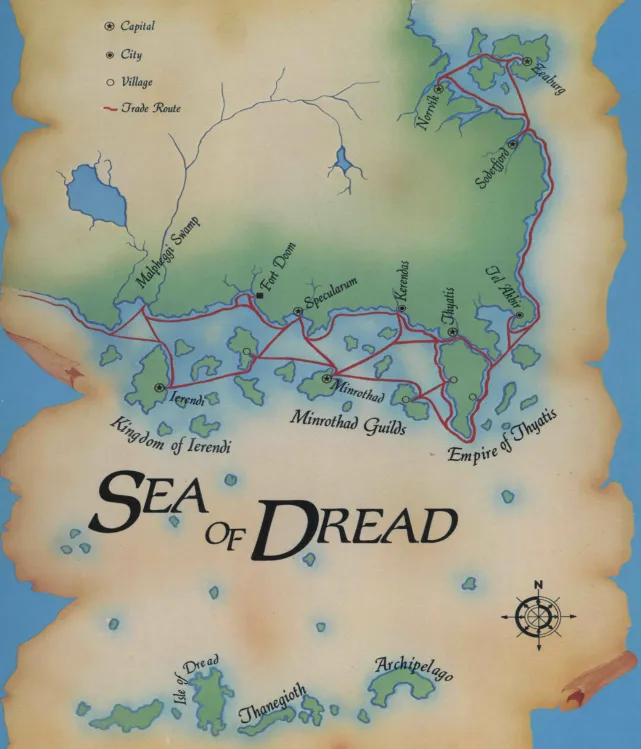
The map at the top of this post is provided to you as a player, although since it's at the last page of the adventure I didn't actually realize it was there during most of my playthrough. But, as you can see, without including measures of distance, it's only really helpful in determining the relative positions of one place to another. You know the Empire of Thyatis is east from the city of Specularum, but not how far to travel before you get there.
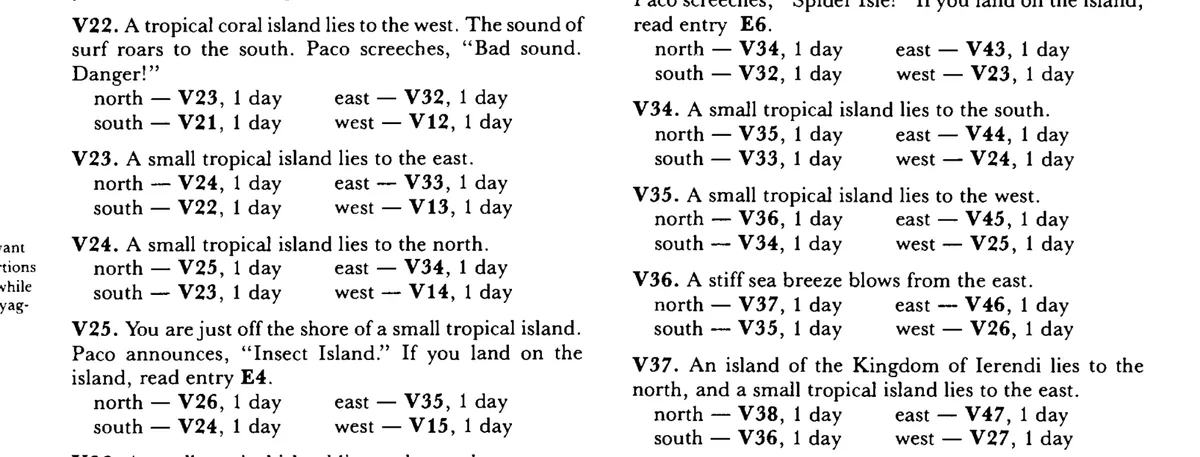
Once you're in the midst of the choose-your-own-adventure navigation, you're just getting a vague description of what's nearby and choices of which direction to travel in, leaving you to somewhat guess which way to go and for how long to try to reach what you're looking for.
In actually playing Lathan's Gold, all of the potentially interesting navigation challenges are obviated by the fact that there's a fortune teller in the starting city who will give you precise directions to any of the places you might want to go. She costs money, but I always had enough to pay for it, so navigation was actually just straightforwardly following directions.
But, I think there's something interesting about the idea of the navigation system if the turn-by-turn directions mode wasn't available.
How is this like Early Navigation?
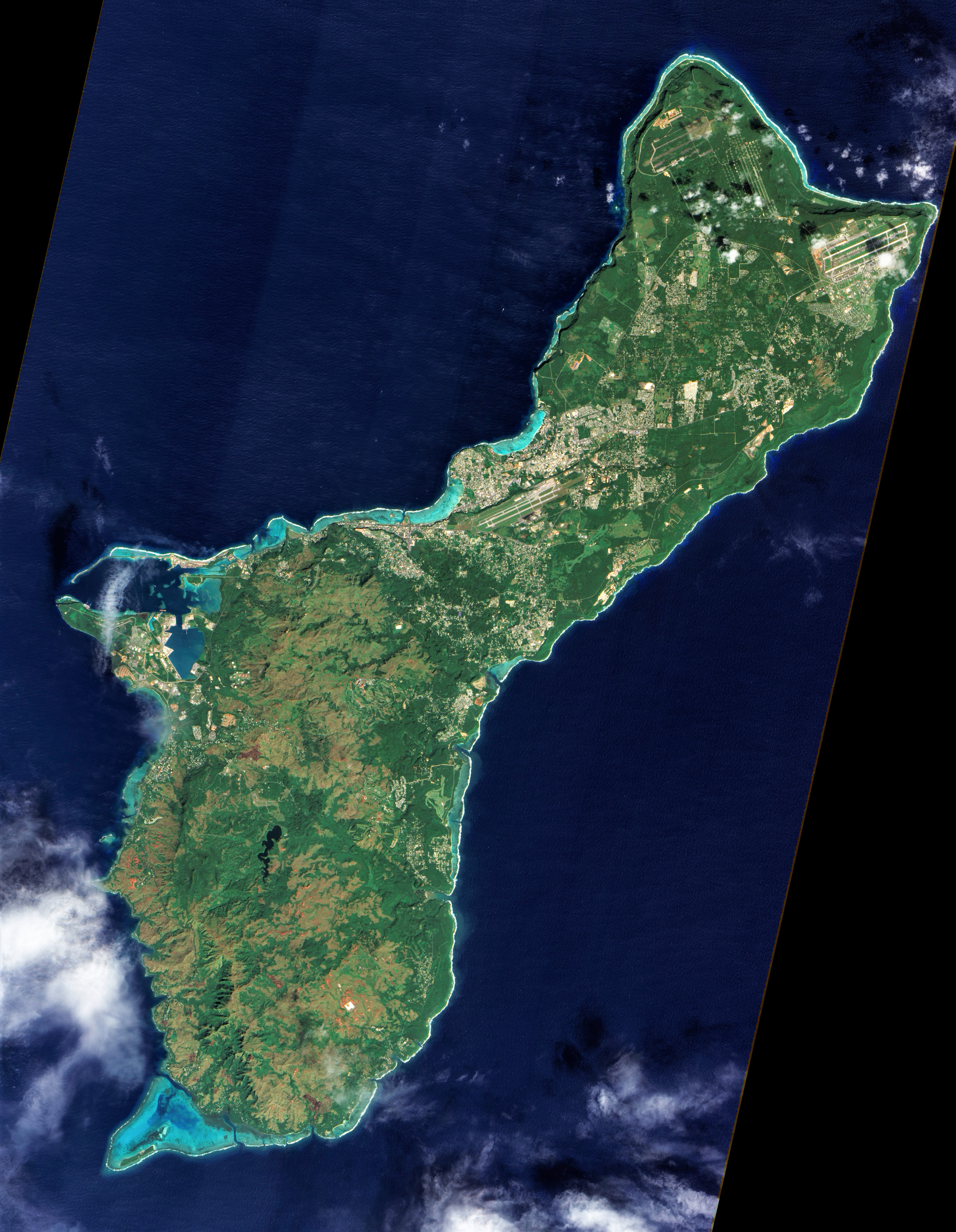
While they had tools to help them, and many did successfully navigate across the oceans, early navigation also involved a lot of guesswork. For one thing, the maps were pretty bad. One of my favorites that I see a lot in my own day job is this 1676 map of Guam, which you can see compared to a modern map is pretty hilariously inaccurate (note the 1676 map is flipped on its side, so the top of the map is east).

Trying to navigate with a map that fuzzy would be bad enough, but that wasn't the only thing making it complicated. For one thing, even though compasses were available, due to magnetic variation, they don't always point due north. On top of that, while navigators could generally determine their [https://en.wikipedia.org/wiki/Latitude], or location north or south of the equator, with tools such as astrolabes, there was no reliable way of determining longitude, or location east/west, before the invention of marine chronometers in the late 1700s. Prior to that, dead reckoning was used to estimate position east/west by knowing your starting position, travel speed, and direction, and mapping out how far you would have moved on the map based on that. Needless to say, this was never particularly accurate, as measuring all three of those variables with the available tools left plenty of room for error.
Considering all of that, a system like Lathan's Gold, in which you're just picking a direction and traveling that way for a day before picking a new direction and hoping you're heading toward the right spot on the map, doesn't actually feel too far off from how things really were back in the day.
Should We Use It?
I don't know if/when I'll be able to playtest this, but I think a version of this system could be fun in play in an exploration-focused sea campaign.
Give the players either no map or a pretty inaccurate map and set them loose, picking a direction and seeing if they can find what they're looking for. Add in the travel speed and wind speed/direction rules from B/X for some more complexity, and I think you've really got some potential here.
Of course, this stays pretty boring if it's just a series of north-south-east-west choices hitting dead ends until you finally make it where you want or give up. So, I think the key would be having interesting wandering monsters and random encounters out at sea, including other passing ships that can provide directions, as well as lots of other small places, perhaps some unmapped, so end up at if you don't find what you were really looking for. Perhaps even a random island generator to fill in the gaps as needed.
Give yourself a grid map as Referee so you can track where they actually are, and I really think you might be cooking with this.
This isn't something I'll be taking the time to formalize anytime soon, but please someone else take it and run with it!