De Venenis - A Treatise on Poisons in Old School Gaming
Let's Make Poisons More Interesting
Introduction
Work on this post started because I'm tinkering on a dungeon that will involve a lot of poison and before really getting into writing it, I wanted to decide how to handle it to center poison in the gameplay. I plan to write it for Cairn, which doesn't have much formally related to poisons in the rules and, from what I've seen so far, mostly just adapts how it's done in older editions of D&D (more on that below).
What I'm looking for in a potion system for this dungeon is:
- Interesting consequences/symptoms beyond death;
- Unique symptoms so that the type of poison could be identified;
- Unique antidotes so that finding a cure becomes a bit of a puzzle between identifying the poison and antidote and then finding and preparing/using the antidote.
This is all inspired in large part by a session of Force and Destiny I played in years ago. We were poisoned near the start of the session and knew we had only a few hours in-game until we would be turned into zombies as a result. It was one of the most intense sessions I've ever played in, with my character ultimately dying after all but one dose of the antidote got destroyed and he gave up that dose to his best friend. I'd like to recreate some of that intensity in how this dungeon works, making surviving the various ways you might get poisoned in there the focal point of it.
I went down several rabbit holes thinking about this, including researching medieval texts on poisons and diving through how other games have handled it over time. I've more or less settled on how I think I'm going to do it, and you can skip down to that if you want. But, I'm also going to share what I've learned with you in my research first.
Medieval Understandings of Poisons
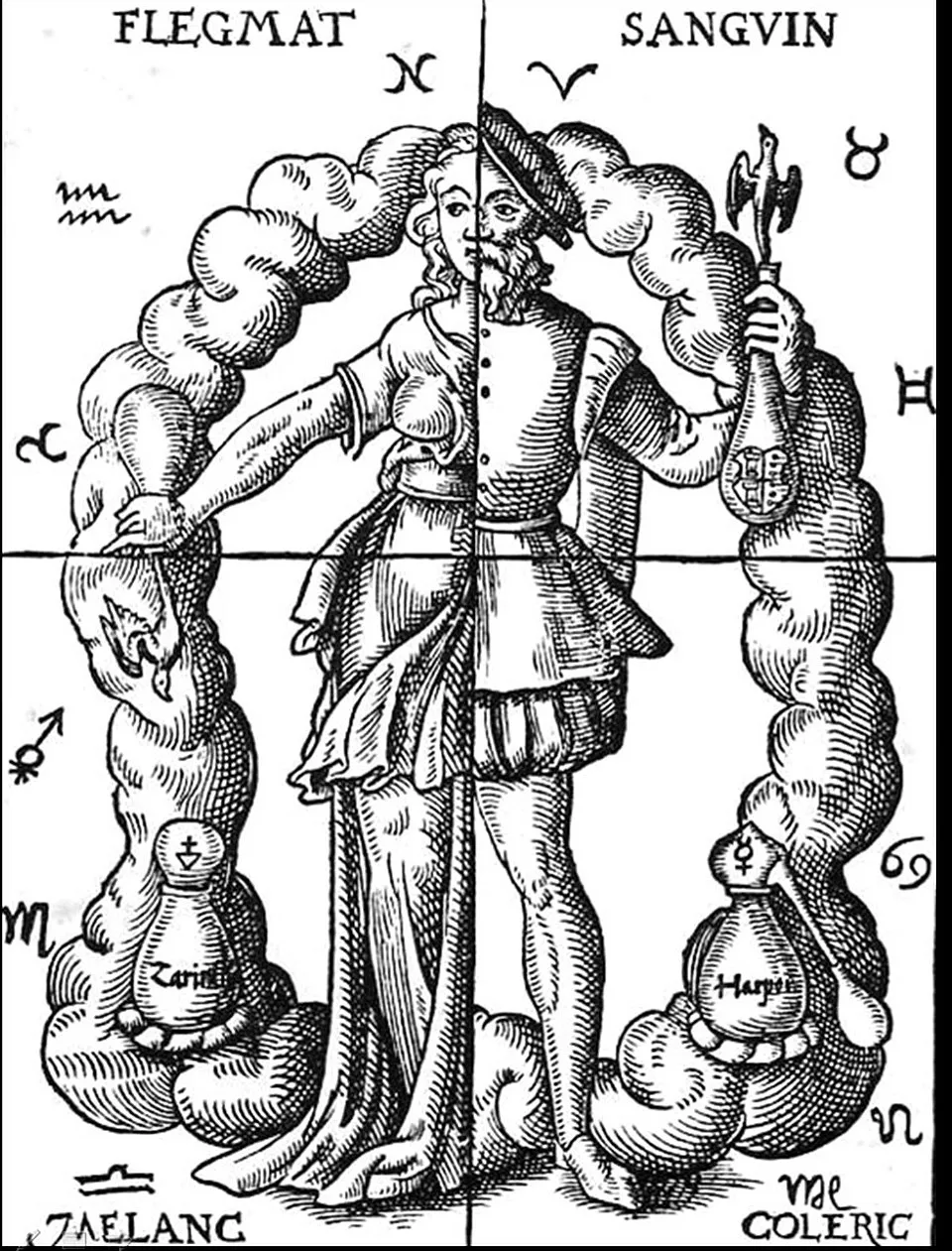
My first thought was to design a system based in humorism in which poisons could be defined by how they affected the four humors (phlegm, blood, black bile, and yellow bile) in different proportions. This would be appropriately medieval and could conceivably deliver an appropriately gameable number of poisons through recombination.

Before doing that though, I decided to research how actual medieval doctors rooted in humorism talked about poisons. I found a very thorough article covering the history from Galen in the 2nd century through Arab authors in the 11th to 14th centuries and various European authors into the 16th and 17th centuries. The article is in French, but easily readable through your browser's machine translation if you're interested in more.
The summary of what the article says, is that while Galen and some other early authors claimed they could explain poisons only through the four humors, they could draw no real distinction between poison and medicine when doing so. Instead, over time, authors built on each other--through a series of treatises all called "De Venenis" hence the title of this post--to develop the idea that even though poisons were made of components related to fundamental elements, it was their "specific form" that gave them their ability to poison, and that was far more complicated and somehow related to astrology. The key takeaway though, is that each poison can only be discussed as a unique substance and each has its own set of symptoms and antidotes to it.
I thought then to try to look through a list of poisons from a source from the time, and found a 1663 treatise conveniently written in English by by William Ramsey and transcribed digitally by the University of Michigan. But, what I found therein was that most of the poisons either shared their symptoms with most other poisons or had vaguely described "horrible symptoms." Many of the antidotes were also repeated between them.
This isn't to say there's nothing valuable in the book. There's an extended section on rabies or "Madd Dog" poison, as it's called in there, that's fascinating. It also has interesting tidbits dipping more into folklore than medicine, such as the idea that salamanders poison fruit when they crawl on it and descriptions of dragon and basilisk poison.
Also of interest is how it talks about how variable the timing of the onset and progression of symptoms can be, which they believed related to a persons humors and other conditions at the time they were poisoned.
But, at the end of the research, I was left thinking I just needed to design my own system with unique symptoms and antidotes and with variable timing for the onset and progression of symptoms. So, I next turned to looking at how poisons have been done in other games and on blogs to see if someone else had already designed a system that would do what I wanted.
Poisons in TTRPGs
This review is limited to TTRPGs I have access to, and certainly won't cover everything out there. If there's a cool poison system in a game I missed, feel free to email me or hit me up on Bluesky to talk about it.
OD&D
Poisons are unsurprisingly but frustratingly vague in the little brown books. Men and Magic provides the table for the poison saving throw, as well as the Neutralize Poison spell and a clarification that poison doesn't count as evil for the purposes of Detect Evil. The section on the poison saving throw states that failing a throw means you take the full effect of what you were saving against, while passing a saving throw against poison means you take half damage from the poison.
However, if you look in Monsters and Treasures or The Underworld and Wilderness Adventures, neither provides stats for any poisons with a damage range. The only entry explicitly talking about how a poison works is Yellow Mold, which states that you die if you fail the save.
B/X
Relying on [OSE] here rather than the various editions of the Basic and Expert rules, poisons are still not explicitly defined well, but there's more of a sense of how they work. Unfortunately, how they work is pretty boring. It's all just variations on how quickly the poison kills you if you fail your save. Some, like the killer bee kill you instantly if you fail the save, while others make the period until death turns or days.
The tarantella is an interesting exception, forcing you to dance uncontrollably if you fail the save. But they're otherwise primarily focused on the danger of a single dose of poison bypassing your HP to just kill you. While this is a legitimate threat, it doesn't necessarily make for interesting gameplay.
AD&D
First edition AD&D systematizes the B/X version of poisons more, classifying them based on how they are administered, time until the onset of symptoms, and the damage taken on a failed or successful saving throw.
The [monster manual] includes a few interesting variations, such as the bone devil causing strength loss, the erinyes causing the victim to faint, or the ghast causing the victim to vomit.
These are getting better, but still not really doing things in the way I'm looking for.
Second Edition AD&D uses effectively the same system, although stating more explicitly in the text that some other effects, such as paralysis, can also be used.
Later Editions
Since I was already looking through D&D by editions, I took the time to look at everything after second edition to see if there was anything good there--spoiler alert, not really.
Third Edition systematizes things further, distinguishing between effects that occur immediately on being poisoned as well as secondary effects that occur later, and also formalizing how many poisons will do direct stat damage rather than just HP. Fourth Edition does a variation on the same thing, providing a "poison statblock" template.
Fifth Edition primarily relies on the poisoned condition (disadvantage on all dice rolls) but throws in a few interesting alternate effects on some poisons.
The OSR
Looking around at various OSR games in my collection (Cairn, Knave, MÖRK BORG, Errant, Tunnel Goons, Mausritter, Perils & Princesses, et al.) most are far enough into the "rulings over rules" end of the spectrum that they don't define how poison should work, leaving it up to the referee to figure out for themselves.
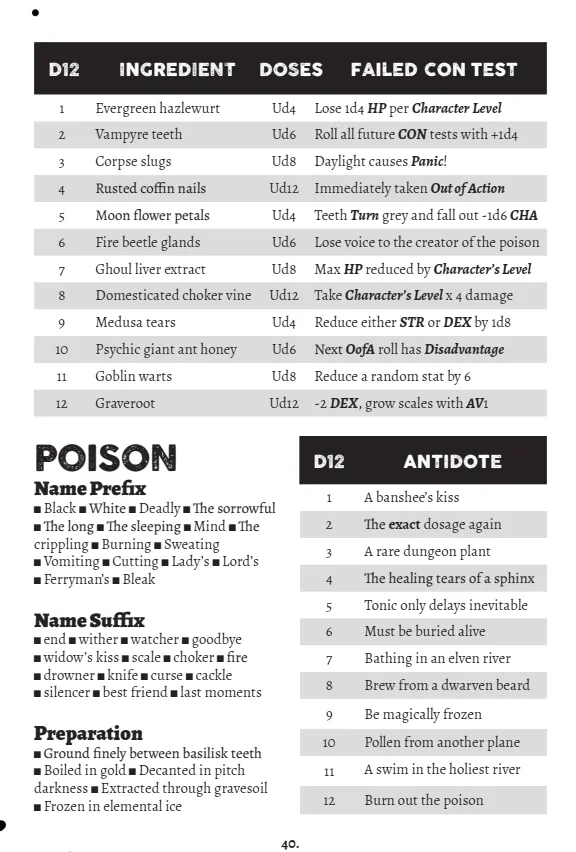
One interesting exception is The Black Hack 2e which does include an explicit poisons system. I never ran into using poisons when I ran TBH before, so I don't know how it works in play, but I like the direction it goes in. In typical fashion, it provides tables for randomizing the ingredients, names, effects, and antidotes for poisons, and it uses the usage die to determine how long you have until you die from the poison. I don't like the randomness of the system for my specific purposes, but it's definitely more in the realm of what I'm looking for, and has some interesting ideas on unique effects from poisons.
Poisons in the Blogosphere
Of course, published games are far from the only source of systems in the OSR, and there's plenty of ideas floating around the blogosphere as well. I had a surprisingly hard time finding poison-related posts just by searching, but I found some, and friendly folk on Bluesky also submitted a few when I put out a call for help. Let's look at some of them below. Again, if you know of a good one I missed, reach out to me, I'm eager to see more of what's out there.
 Elm Cat's fantastic Blogosphere Map showing Cat's Have No Lord in the wastelands of the middle of the sphere along with of Dice and Dragons and Luke Gearing.
There's a few themes among the blog solutions for poisons, mostly focusing either on making poisons more streamline and consistent or making them weirder and unique. Let's look at some posts in both of those realms.
Streamlined and Consistent
Sean McCoy has an elegant system tying poison to HD and character level. I think I would prefer something like this in most cases, just not when I'm trying to make poisons more puzzle-like.
Toucan't Sam wrote a fun little system in response to my request for help, modifying a scarcity dice mechanic from Rise Up Comus to decide if you're poisoned by something or not and how much damage it might do.
Arcane Sword has a time-based system making each poison deal a set die of damage each round a poison save is failed until the character dies.
Ten Foot Polemic devised a system of poison tokens allowing poison to still bypass HP but not be a pure "save or die" scenario, while also mixing up the effects of particular poisons. Rose and Kingfisher provides a variety of poisons to work in this system, making each more unique, but still keeping the core token economy, and later added a random table of poison effects, leaning more into the second category of systems.
Weird and Unique
ktrey, the reigning champion of d100 tables, provided a generator giving you a random disease along with its symptoms and cure. This is essentially a randomized version of what I'm looking for. A ton of good ideas in here, even if for the sake of the puzzle element it's not precisely what I want to use.
Playthings of Mad Gods has a system that's actually essentially what I aim to do. The system defines poisons based on how long it is until the onset of symptoms, what the symptoms are, when the character can make a save to clear the poison, and the effects of success or failure on the save. Below, I'll be adapting this system a bit to my personal taste and to the mechanics of Cairn and provide a few sample poisons.
My System
Adapting from the Playthings of Mad Gods system, this is how I think I'll do poisons in Cairn for the dungeon I'm working on. As stated up top, the main point is to turn poisons into puzzles to be solved, forcing players to identify what has poisoned someone and rush to search for the antidote before it's too late.
This will differ from other systems in a few ways:
Because becoming poisoned will almost always be the result of a failed save (either a save to avoid a trap or a critical damage save) there is no save to make when you are first poisoned. You're just poisoned.
I'm combining the latency period and turning point from the Playthings of Mad Gods system. When you first start to feel the effects is when you make a save to see how bad things get from there.
Each poison by definition has a unique set of symptoms so that it can be diagnosed.
Each poison has a unique antidote so that, once it is diagnosed, players can try to fix it.
Most poisons eventually lead to death. Stakes are high here baybee.
Poison descriptions will be as follows:
Name
Onset of Symptoms - Time until symptoms first appear and a save is made
Save - Stat used to make the save when symptoms appear
General Symptoms - List of symptoms unique to this poison
Symptoms on Successful Save - What occurs when the save is successful, including a duration until the symptoms abate
Symptoms on Failed Save - What occurs on a failed save, including a duration until death occurs
Antidote - Antidote unique to this poison
In how I'm envisioning it now, the players would also be provided with a diegetic treatise on poisons so that they can interact with that to diagnose and find cures if/when members of the party become poisoned. If time is particular of the essence, there could be a save involved to find the information in time, while in other cases they could use real-world time to figure it out.
Example Poisons
Here's a few examples based on some of the poison descriptions in William Ramsey's De Venenis. There will be many more to come when I get to more seriously working on this dungeon.
Mandragora
Onset of Symptoms - 2d4 minutes
Save - WIL
General Symptoms - Extremely dry and inflamed mouth and tongue.
Successful Save - Fall into a deep sleep within d10 minutes of successful save. Sleep for d10*10 minutes or until woken with a pungent smell (e.g., pepper or mustard).
Failed Save - Lose 1 WIL per hour, senses and mental acuity becoming increasingly dulled, until death at 0 WIL. Application of rose oil to the head slows this to 1 WIL every other hour, but does not prevent ultimate death.
Antidote - Scordium and Oregano mixed with wine reverses course of symptoms immediately. Regain 1 WIL per hour, sense and mental acuity becoming sharper, until returned to maximum WIL.

Salamander Bite
Onset of Symptoms - 1d4 hours
Save - STR General Symptoms - White spots appear on the skin, first around the bite and then spreading over more of the body.
Successful Save - Spots recede except for at the location of the bite. Spots around the bite first turn black within 1d4 hours and then will begin to putrefy. If antidote is not administered within 1d4 days, the putrefaction will spread and the affected flesh must be scarified or the affected part amputated. Otherwise, effects thereafter are the same as on a failed safe.
Failed Save - White spots turn black within 1d4 hours and then begin to putrefy. Hair falls out after 1d6 hours. Affected flesh or body parts begin falling off after 2d6 hours. Death in 2d6+4 hours.
Antidote - Scarification or amputation of affected flesh and body parts will halt spread around that location. A poultice of pine resin, garlic, salt, and honey placed on affected flesh will draw out the poison in 1d4 hours.