
Tracking the Storm
This is my final entry to the current blog bandwagon before it closes soon. I previously posted a keyed version of the incredible map Amanda Lee Franck did for this bandwagon and also a consideration of the way ocean navigation is handled in the module XSOLO: Lathan's Gold.
I thought those would be my only contributions this round, but then Typhoon Sinlaku hit the island where I live, and I was inspired to think about how you would map and track a massive storm like this in an old-school game. I had already been thinking about sea travel and weather for my Mangayaw campaign, which will be restarting once we're further along in recovering from the Typhoon, so my mind instantly turned to this as the storm was approaching us. Tracking some of the effects of the storm as they happened provided a much needed distraction from the anxiety of waiting for the Typhoon to hit, and I also owe big thanks to folks on the Prismatic Waystation Discord, like Zak H., Elmcat, Ty, anyone else I'm forgetting, and the birdman himself for helping me talk through some of this and aiding my distraction during those tough days.
Before getting to the meat of this post, I want to call out again that I'm organizing an Itch.io Charity bundle to support Typhoon relief here. Reach out to me if you're interested in joining, and keep an eye out for when it launches. In the meantime, you can also donate directly to Micronesia Climate Change Alliance who have stepped up to fill some critical gaps in relief supplies while we wait for bigger government help.
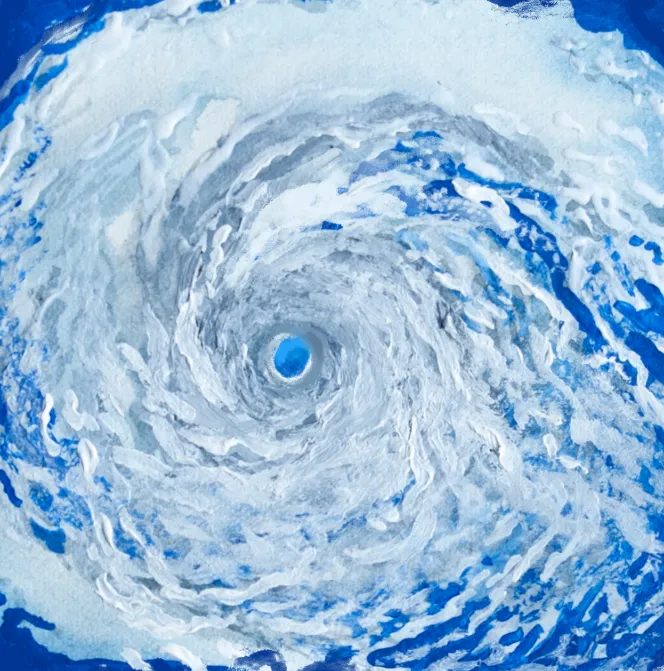 Painting of the Typhoon donated by Amanda Lee Franck for the charity bundle.
What is This Trying to Accomplish?
Before diving into the system itself, lets talk about what I'm trying to accomplish here. I think this helps evaluate if it actually works and also helps others build on it if there's a better way to do this.
There's a few things based on my experience of this and previous big cyclonic storms (I count at least four big hurricanes from my time in North Carolina and three big typhoons here on Saipan) that I want to make sure this system emulates:
1. They're Huge
I haven't found an official measurement anywhere, but measuring the screenshots I took of the weather radar for Sinlaku in Google Maps, it looks to be 500 to 600 miles across from edge to edge, while the diameter of the eye was about 100 nautical miles. We'll be using nautical miles throughout this post, as it fits well into games involving sea navigation. The main point of this is that we were feeling the effects of the storm while the center was still hundreds of miles away from us and we continued to feel the effects for days after it had passed. Exactly how long a location is affected relates to the next point though.
2. Speed matters.
In 2018 we were on Saipan for Super Typhoon Yutu. That storm was bad. But, while its wind speeds were higher than Sinlaku, the experience of Sinlaku was much worse because it was moving much more slowly. This is the first thing that comes up in conversation here right now with anyone who experienced both. Yutu battered Saipan overnight, but we were able to start cleaning up already the next morning when the storm had passed. With Sinlaku, the effects of the storm started Monday evening, the worst parts were Tuesday night, but we weren't actually able to start cleaning up until Friday because the dangerous conditions continued through all of Thursday that week.
3. Unpredictability
For those experiencing a storm like this, I think the anxiety of the unpredictability is largely a modern phenomenon as we constantly check weather radar and storm tracks. On the Friday before the storm, I came back home from a trip to Guam and felt grateful because at that point it looked like the storm was tracking to Guam instead of Saipan. But, over the following days the track turned further and further north. After hitting us, it tracked almost directly north and continued to hit other islands further up in the chain. For players, this part doesn't matter as much, but as a Referee, I'd like a level of simulationism here, tracking hexes the storm might go to. The one constraint is that it will never just turn around and go back the other way, it can either continue on its course or shift one cardinal direction off off it--a storm traveling East can shift north or south, but won't suddenly start traveling West.
With those things in mind, lets sketch out what I'm thinking for this.
The System
When a storm like this occurs depends on the weather system in your game of choice. For me in my house-ruled version of Mangayaw (which I'll eventually post about) this would be an "Extreme" weather result, which is most likely during the wet season from March to October, but is possible during the dry season from November to February. This would vary in other games. But the focus here is on how to handle the storm when it arrives.
A typhoon is defined by three traits:
- Size
- Speed
- Direction
With these three things, you can determine what effects are happening in particular hexes at a given time, as well has where and when it moves across the map. Let's look at each individually.
For all of these, we're using 60 nautical mile hexes, which corresponds to an average daily rate of travel for traditional sailing craft. I came up with this on my own when doing research for Mangayaw, but I was pleasantly surprised to see that same unit of measurement is being used in Islands of Weirdhope, which has inspired some of my house rules for maritime travel. If you want to convert it to whatever map you're already using, 60 nautical miles is approximately 70 miles. Since there's such a proliferation of hex sizes about, I'll leave it to you to do the conversion to hexes if you use it.
If anyone happens to be playing a game set in Island Southeast Asia, I do have a map overlaid with 60 nautical mile hexes already if you care to use it.
Size
For size, we're going to keep it simple with Small, Medium, and Large. While real eye size can vary, we're going to keep that at a single hex and adjust the rest outward from there. The storm itself consists of the eye hex and then three bands of hexes around it, with the effects becoming more intense the closer you come to the eye. The bands are light, moderate, and heavy.
A small storm consists of the eye and three one-hex bands around it.
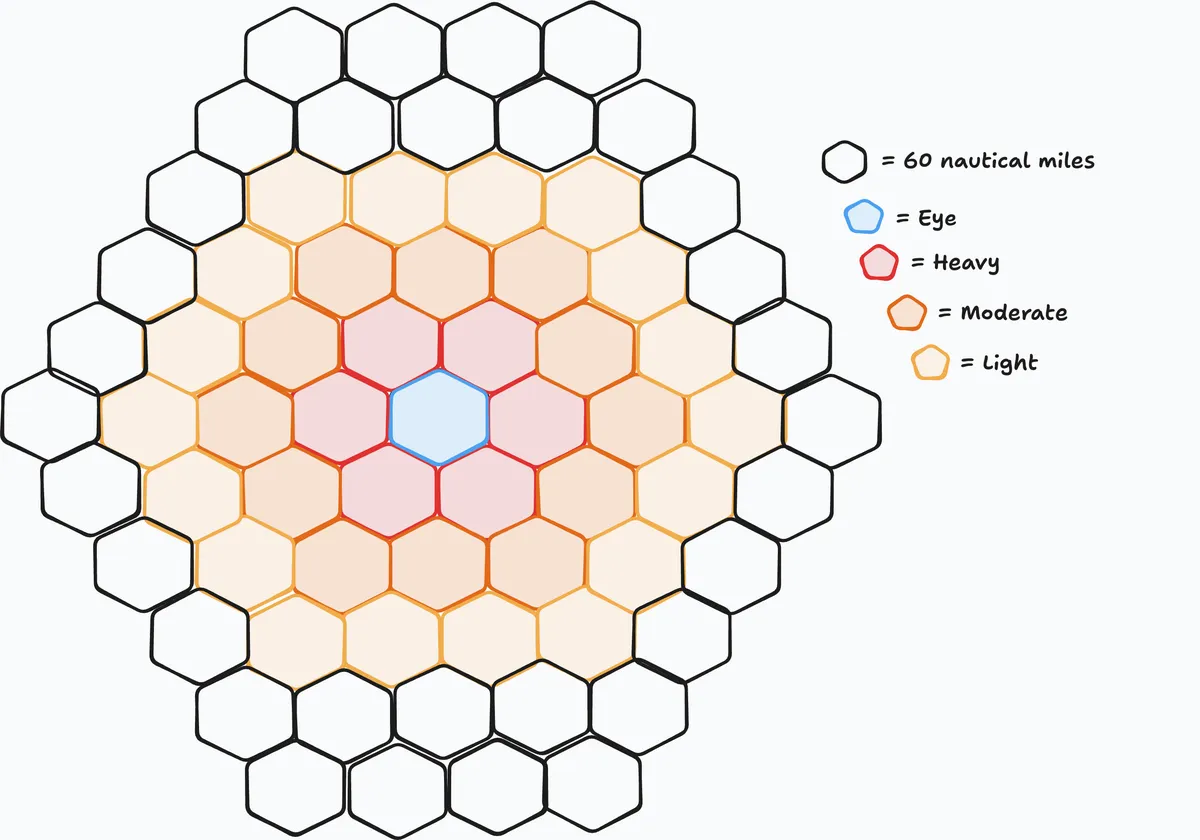
Add one hex width to each band for each size category above small.
Speed
Keeping things in threes, there will be three speed categories: slow, normal, and fast.
Slow - ~4 miles per hour or 1 1/2 hexes per day or 1 hex every 16 hours Normal - ~8 miles per hour or 3 hexes per day or 1 hex every 8 hours Fast - ~16 miles per hour or 6 hexes per day or 1 hex every 4 hours
Each time the storm moves a hex, move the eye first and then redraw the bands around it. Which hex it moves to depends on its movement direction, which may change each time the storm will move a hex.
Direction
The Referee determines what direction the storm is moving when it first appears, or may roll d6 assigning numbers to each side of a hex to decide which direction it is moving.
Each time the storm will move to a new hex, based on its speed, roll d3 (d6/2) to determine which direction the storm moves. Assign the numbers 1-3 to the face of the hex corresponding to the direction it last moved and to the two adjacent faces. This is to avoid drastic changes in its direction. If the storm last moved northwest, it can now move northwest, northeast, or west.
Effects
Individuals experiencing the storm are subject to the following effects based on which band of the storm they are in. This is based loosely on my own experiences of the most recent storm, but could probably be improved with additional research. For instance, I don't know what the experience is like at sea. I also wasn't tracking things too closely when we were sheltering during the worst parts of the storm, so I only saw the aftermath.
Light
The sky is completely overcast. There is frequent, but not constant, rain. The winds are faster than normal, but not truly dangerous. It is clear a big storm is coming. Temperature drops. The wind begins to gust unnervingly. Now is the time to take shelter if you can, but travel remains possible.
Moderate
Heavy rain constantly, usually blowing sideways in the wind. The rain hurts when it hits your skin. Wind is heavy and sustained, with dangerous gusts periodically. Large trees bend in the winds, while smaller branches and trees are beginning to break. It can be difficult to walk during the heavy wind gusts. Travel is very difficult, but still possible with determination.
Heavy
Constant sideways rain. Trees are being uprooted. Large branches are breaking and falling. Wooden structures will have their roof torn off or their walls collapsed. Large debris is blown around long distances. You will be hit by something flying if you stay out too long in this, let alone the rain pelting you. Low lying areas are flooding. You can't really try to go anywhere far in this. You will get hurt.
The Eye
A break of calm, clear skies before it all starts again.
Room for Improvement
This is a first draft, and could absolutely be improved. I think there could be a better list of effects with mechanical consequences. I think it would be good to have chances for the storm size and speed to vary over time. I could figure out how to have larger or smaller eyes while still working on hexes.
But, this is something, and all you're going to get out of me now when we're busy with recovery.
Hope this was interesting, and please consider donating to recovery efforts.