
Why Are You Like This?
XS2 Should Have Been Better
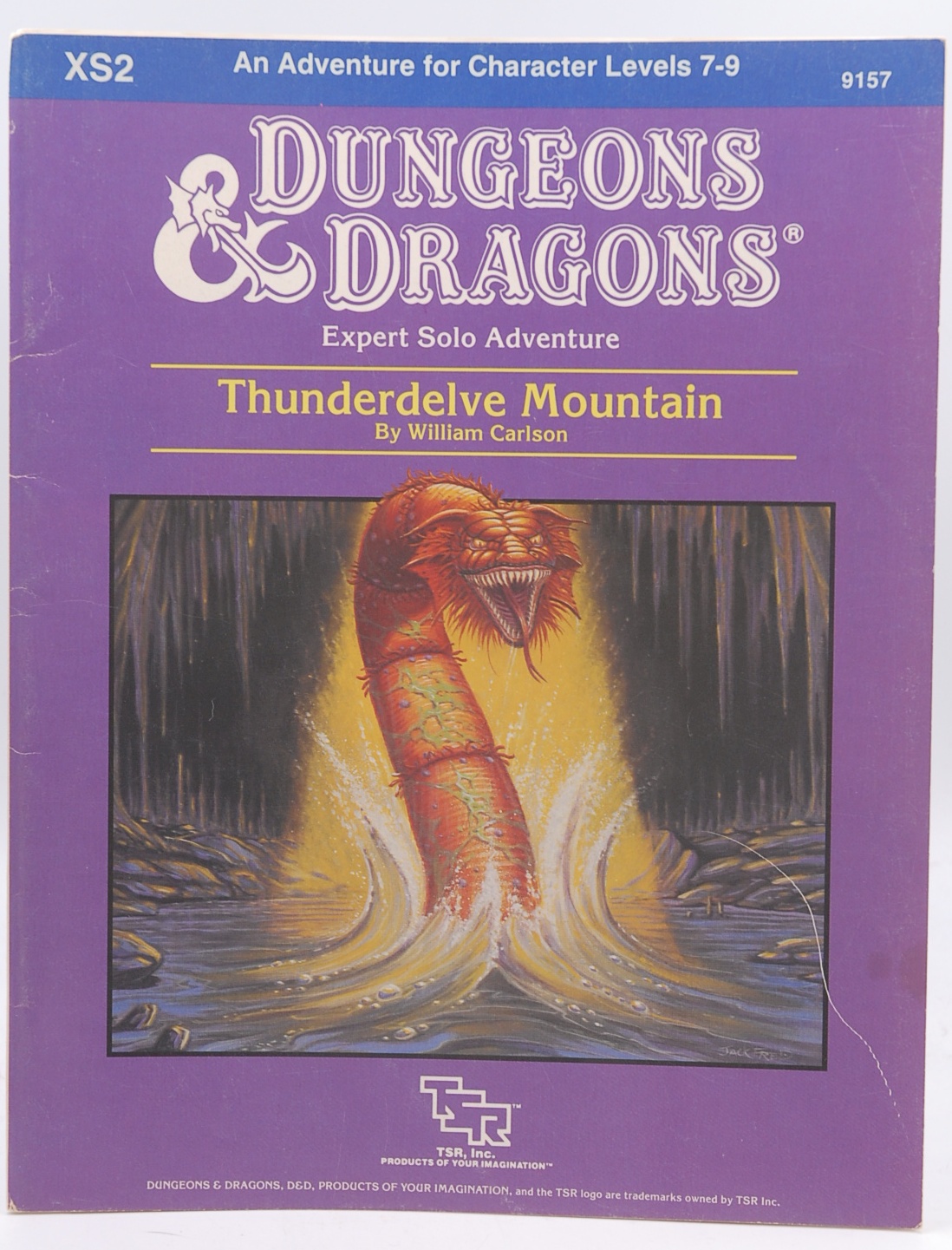
In this post I discuss XS2: Thunderdelve Mountain, the last solo-adventure for B/X Dungeons & Dragons published in 1985. This is a follow-up to my playthrough and review of BSOLO: Ghost of Lion Castle. Since playing BSOLO, I've been struck with the urge to try to make my own choose-your-own-adventure style old school adventure, but I wanted to see what all had been done before setting out to write that.
I had fun playing XS2 recently over the course of two 20+ hour trips to and from the mainland from my home on Saipan, and I want to start this out by emphasizing that. Despite all of its flaws, this was a fun experience to play through. It has an interesting dungeon to explore and plots to uncover, and it makes some good innovations on the systems used in BSOLO. But, I'll be mostly discussing the flaws, as that's where my head has been trying to think about how I want to do something like this.
The rest of this post is full of spoilers for XS2. Don't read it if you plan on playing the adventure.
My Experience of XS2
The story of this adventure, briefly, is that you're sent to help a group of dwarves reclaim a dungeon that was taken from them by a dragon. First you must rescue the daughter of the last dwarf lord from a group of bandits and goblins. Then you must find a magical hammer. Then, you must mentally fight with the hammer and go to fight the dragon and reclaim the dwarf halls.
As with BSOLO, playing XS2 felt very much like playing an old computer adventure game, except even more so. In XS2, you're encouraged to start your new character in the same location as the old character when they die, just without the treasure they had collected. I eventually stopped counting how many characters died for me once I got up over a dozen, as it didn't really matter. While they were technically new characters each time, it felt like just a continuation of the last one. There's pros and cons to this I'll discuss below.
I personally had the issue that I was playing with the PDF from The Internet Archive, which is missing several pages containing locations that are critical to completing the first plot arc of the adventure. I'd recommend purchasing the version off DTRPG instead. While I found ways around this--first exploiting a loop in the dungeon I'm not sure should exist, and later just jumping to the next part of the plot--it definitely made things less enjoyable in the end.
Despite the frustrations of the near constant death and the missing pages, I had a good time. While this adventure could be improved in many ways, it's still fun to explore the dungeon, map it out, translate dwarven runes, and fight monsters. Below we'll get into the good parts of the adventure first, and then tackle what I want to be better about it.
As for how I played, I did it entirely on my tablet and phone during my flights. I'd like to shout-out the OSCharacter App, which lets you easily build and manage OSE characters, and [Dungeon Dice(https://apps.apple.com/us/app/dungeon-dice-rpg-dice-roller/id1405198378), which does exactly what you want it to. I also used a PDF editor on my tablet to draw and write on top of the adventure PDF.
The Good
There's a number of things I really found good about this adventure: the mapping experience, translation, and the events system. I'll talk about each more below.
1 - Mapping
I think my favorite aspect of this adventure was mapping out the dungeon through play. Unlike BSOLO, which gives you a full set of maps to mark up as you discover secrets on them, XS2 gives you a page of graph paper with only the two known entrances to the dungeon marked on them. Each new room you enter gives you a snippet of the map to fill in, slowly revealing the dungeon as you go.
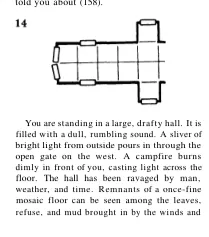
In the end, hidden places, loops, and a giant chasm all reveal themselves in a super satisfying way. All I can say is that the adventures nails it when it comes to dungeon mapping as a part of the old school experience.
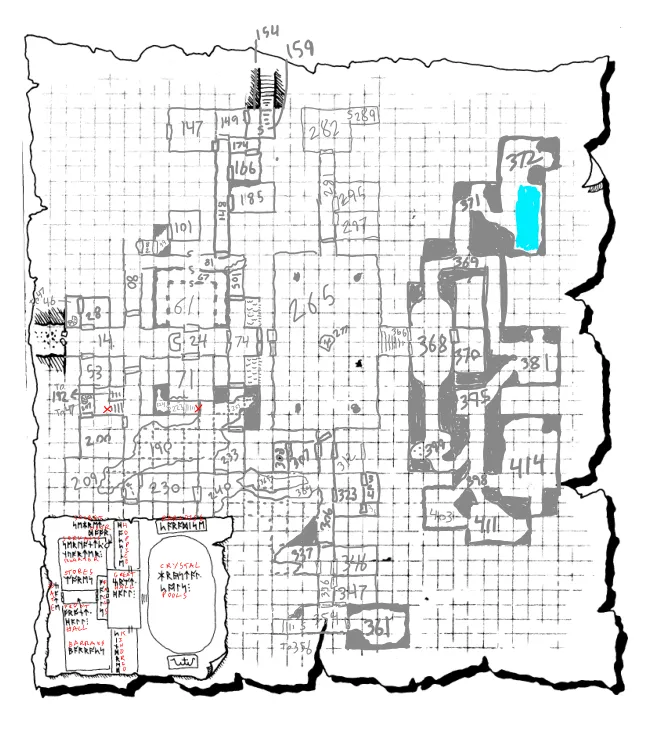
You'll notice a section missing in the northwest corner, which is from the missing pages of my PDF. Also important to note is how some paths over and around the chasm can lead you into Room 265, which you're seemingly not intended to go into until you've completed the first plot arc, but we'll get to that. The point is it's a fun map and the experience of mapping it out was enjoyable.
2 - Translation
Another big part of the adventure is translating dwarven runic texts to provide clues for navigating and solving puzzles. There's 19 rune inscriptions, many of which are one or two words, but a few of which are full-length pages of text.
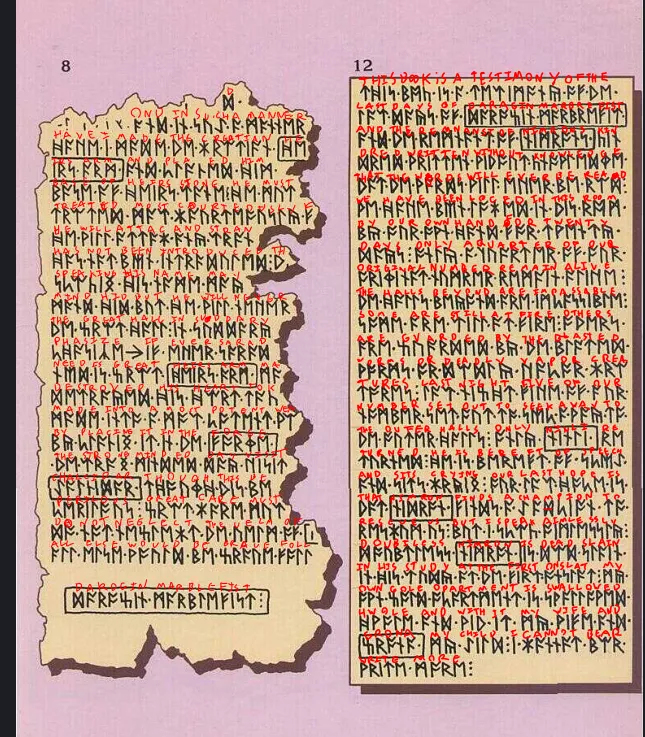
The act of translation and slowly revealing information about the history of the dungeon was time consuming, but fun, especially once I started to recognize the runes and could move through it more quickly. There's some seeming misspellings throughout, which made things a little difficult, but I was never sure if those were intentional or not.
Not every adventure needs this, but it was fun in this case.
3 - The Event Record
XS2 includes a kind of memory to change future events based on past events. There's a matrix of letters up through NN, and when you collect certain items or complete certain tasks, you cross them out. Later one, when that would become relevant, such as needing a key to unlock a door or entering a room where you already defeated a monster, you're instructed to jump to a new section of the choose-your-own adventure text. While some of the video-game-style gatekeeping between areas of the dungeon this enables got a bit annoying, I think its a useful tool for designing an adventure like this.
The Bad
Despite enjoying the adventure, there's a few things I wish were different: it's too deadly for a single character to survive, the plot structure broken into multiple arcs feels unnecessarily restrictive, and it abandons a number of things that I'd consider critical to old school play. Lets look at each of those a bit more.
1 - Deadliness
Yes, old school play is supposed to be deadly, but what I found in this adventure is that it was impossible to survive more than one or two combat encounters with a single character. They're appropriately balanced for Level 7-9 dwarves, but there's just not enough opportunities to heal in between to allow a character to sustain that many combats in a row. I do wonder if, in part, this is related to the Mentzer-era B/X advice that encourages DMs to fudge dice rolls and just pick a damage number from the range rather than rolling damage. Should I have been easier on myself? Or were there more combats I should just have been running from? I don't know. The situation is improved some by the recommendation to just start your new character in the same locations, but it also starts to feel very video-gamey at that point, and I'd rather have some in-world solution for how that would work.
2 - Railroadiness
Tracy Hickman is credited as a developer on this adventure, and it shows. If you look at the map above, the double doors into Rooms 265 and 368 are both gated artificially by knowledge you're supposed to gain from Nimron the dwarf lord when you return to town after completing the first two plot arcs of the story. It's very much designed to lead you through three distinct sections of the dungeon in sequence.
The first problem I had with this, is that the resolution to the first plot arc is in the northeast section of the dungeon I was missing. Rather than acknowledging this, I decide to try to force my way through other parts of the dungeon to see what's there. The issue that arose is that, the chasm on the south part of the first section is also seemingly intended as an uncrossable obstacle. It's described as too wide to cross in most areas. But, there's a narrow gap at one point and, if you go into that room without a magic weapon, you will be forced to jump across the gap by a vapor ghoul. So, I did that, and ended up on the loop around the south part of the dungeon that does actually connect you to Room 265, as well as containing the magic hammer you can't actually get until you've completed the first plot arc. I'm a bit baffled why it's possible to get down there at all. I would have preferred a more open-ended dungeon with loops and exploration all around, but if you're going to do it like this and restrict the movement through the dungeon to fit the plot, why let anyone down there at all, especially without a magic weapon?
3 - What Even Is The Old School?
As much as we in the OSR like to look back on this period in the 80s fondly, reading anything from this period makes it very clear that it wasn't all Principia Apocrypha, and there was a wide range of play going on, including the trends that lead into Dragonlance and the trad style we've rebelled against. That's all to say, there's no random encounters in this adventure, and I don't like that. Everyone just sits around in their rooms waiting for you to show up. It's particularly frustrating since BSOLO had them and used them to good effect. I'm going to stop here because I've run out of things to say, but where my head is at now is how to combine the sensibilities of XS2 and BSOLO with my own OSR-proclivities into something that's actually good. We'll see where that goes.